Mezanur Rahman Sharukh

Mezanur Rahman Sharukh

Statistician and public health researcher working on national health surveys, epidemiological modelling, and applied machine learning

My work connects classical statistical methodology with reproducible machine learning across environmental exposure assessment, maternal and child health, climate-sensitive infectious diseases, and calibrated clinical prediction. I also build open educational tooling and maintain the free 860-page textbook From First Line to First Paper.

§ 01

Open-access book and software

Open access · CC BY-NC-SA 4.0 and MIT
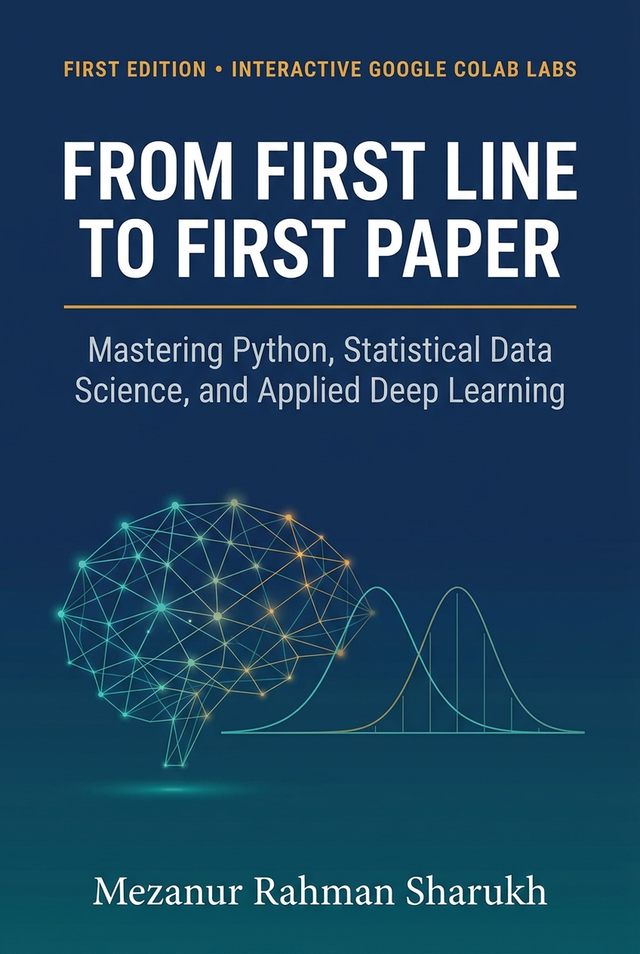
Cover of From First Line to First Paper by Mezanur Rahman Sharukh
First edition, 2026 · 36 ch. + 5 app. · DOI 10.5281/zenodo.24446563

From First Line to First Paper

Mastering Python, Statistical Data Science, and Applied Deep Learning

A self-contained curriculum written for students, statisticians, and quantitative health researchers. It moves step by step from first Python statements and survey data wrangling to biostatistics, leakage-free Scikit-Learn pipelines, PyTorch architectures (MLPs, CNNs, GRUs, LSTMs, Transformers, LoRA), ablation studies, subgroup fairness audits, Decision Curve Analysis, and TRIPOD+AI reporting.

860 Book pages
182 Colab notebooks
324 Automated checks
972 Progressive hints
pip install sharukh-tutor
§ 02

Ongoing research

External overview of active research areas
01
Environmental epidemiology

Environmental exposures and early childhood health

Investigating environmental exposure indicators and early childhood developmental outcomes in nationally representative household surveys through survey-weighted Bayesian modelling and interpretable machine learning.

02
Maternal and child health

Health equity, maternal care, and child nutrition

Examining socioeconomic disparities, maternal healthcare utilization, birth spacing, and child growth patterns across multi-round demographic surveys using multilevel modelling and inequality decomposition.

03
Infectious disease modelling

Climate-sensitive vector-borne disease forecasting

Studying relationships between meteorological variability and infectious disease surveillance dynamics via lagged climate features, statistical time-series forecasting, ensemble trees, and deep sequence architectures.

04
Responsible clinical AI

Fairness-aware and calibrated clinical prediction

Designing probability-calibrated, subgroup-audited machine learning workflows for chronic disease quality-of-life and mental health risk assessment aligned with transparent clinical reporting standards.

05
Field epidemiology

Antimicrobial resistance and community surveys

Building quantitative survey instruments, KoboToolbox and ODK field data workflows, and mixed-methods analytical pipelines for antimicrobial resistance awareness, oral health, and population studies.

06
Open statistical education

Reproducible computational teaching tools

Developing open-source Python packages, automated diagnostic verification engines, and self-contained cloud labs so quantitative health learners can practice reproducible ML without local setup barriers.
§ 03

Published works

Publicly released book and conference proceedings
  • 2026
    Open-access textbook

    Sharukh, M. R. (2026). From First Line to First Paper: Mastering Python, Statistical Data Science, and Applied Deep Learning (1st ed., 860 pp.). Open Scientific Edition / Zenodo.

  • 2025
    Conference proceedings · December 2025

    Sharukh, M. R. (2025). Predicting Anxiety Severity Among University Students Using Machine Learning Models: A Case Study at the University of Rajshahi, Bangladesh. International Euro-Mediterranean Congress on Higher Education, Scientific Research and Innovation, Piran, Slovenia. ISBN 979-8-89695-260-2.

  • 2025
    Conference proceedings · November 2025

    Rimy, H., Zinaoui, O., & Sharukh, M. R. (2025). Comparative Validation of Inertial Sensors (IMUs) and Force Platforms in Explosive Performance Assessment. International Euro-Mediterranean Congress on Higher Education, Scientific Research and Innovation, Emuni University, Piran, Slovenia.

§ 04

Background and methods

Affiliations, training, and technical stack
Research affiliations and education
  • 2025–present
    Research Assistant (Remote)
    Hamad Bin Khalifa University (HBKU), Qatar

    Survey data workflows, statistical modelling, and machine learning in collaborative health data science studies.

  • 2025–present
    Research Collaborator
    Bangladesh Institute of Governance and Management (BIGM)

    Collaborative biostatistics and applied machine learning in maternal and child health.

  • 2023–present
    Research Assistant — Epidemiology & Health Research Labs
    University of Rajshahi

    Epidemiological modelling, infectious disease analysis, population-health data management, and statistical validation.

  • 2025–present
    Lead Researcher (Project Kanon) & Peer Reviewer
    Field Epidemiology · Scientific Research Review

    Quantitative survey deployment (KoboToolbox / ODK), data quality assurance, and statistical peer review.

  • 2020–2026
    BSc (Honours) & MSc Coursework in Statistics
    Department of Statistics and Data Science, University of Rajshahi

    Graduate and undergraduate training in statistical inference, experimental design, sampling, biostatistics, demography, and machine learning.

Methods and computational stack
  • Python, R, and scientific computing

    Python (NumPy, Pandas, SciPy, Statsmodels, Scikit-Learn, PyTorch, Matplotlib, Seaborn, Joblib), R, SQL, SPSS, Google Colab, Jupyter.

  • Biostatistics and survey methodology

    Complex survey analysis, survey-weighted estimation, Bayesian and multilevel modelling, generalized linear and ordinal regression, ARIMA, concentration indices, inequality decomposition, Decision Curve Analysis.

  • Machine learning and responsible AI

    Random Forest, XGBoost, LightGBM, SVM, PyTorch (MLPs, CNNs, GRUs, LSTMs, Transformers, LoRA), leakage-free pipelines, nested cross-validation, probability calibration, subgroup fairness auditing, SHAP, TRIPOD+AI.

  • Engineering and additional training

    Git, GitHub, PyPI packaging, pytest, Quarto, LaTeX, KoboToolbox, ODK. Additional coursework from Johns Hopkins University (epidemiology and surveillance), Imperial College London (infectious disease modelling), and Stanford University (machine learning).